
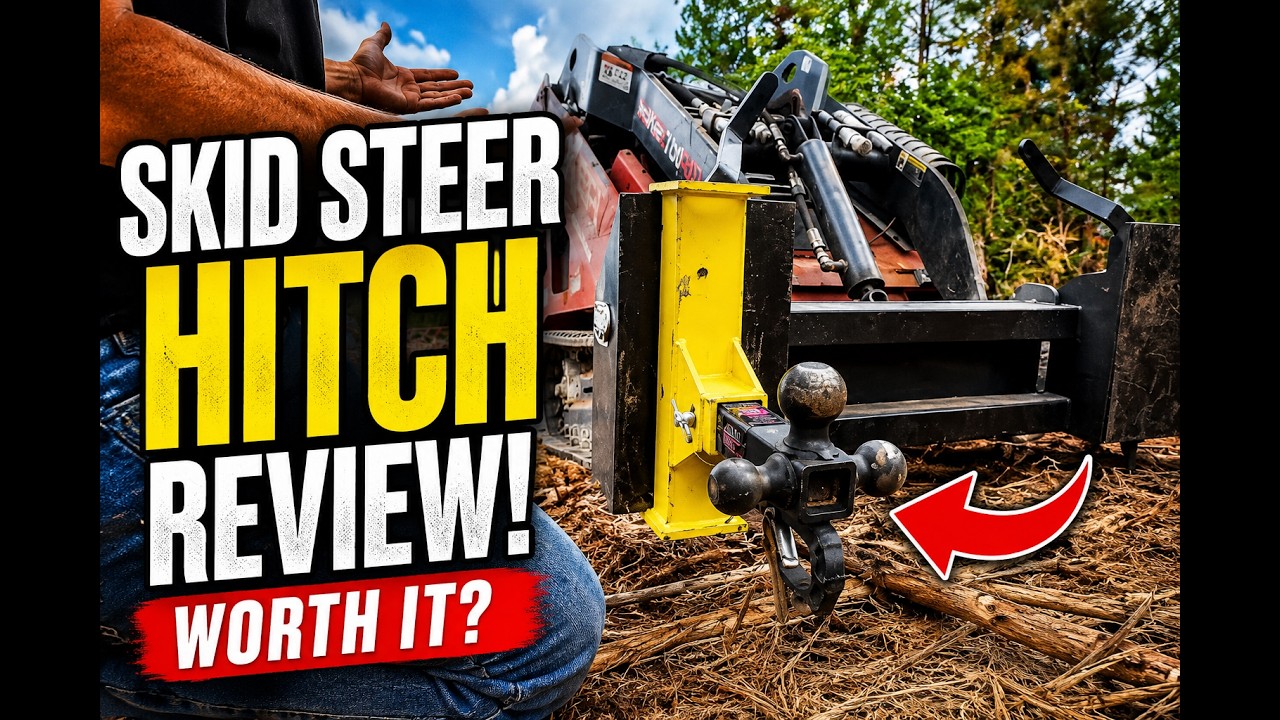
When you work with land, equipment, trailers, and job sites on a regular basis, little tools can make a big difference. One attachment I recently tested was a skid steer hitch designed to let you move trailers and equipment around using a skid steer.
At first glance, it seemed like a smart idea. It was lightweight, simple, and easy to attach to the skid steer. For anyone who has spent time moving trailers around tight job sites, that sounds like a major advantage.
But after using it and looking closer at the design, I came away with mixed feelings.
In short: I liked the concept, but I do not think this particular design is something I would trust for serious equipment moving around a job site.
What I Liked About the Skid Steer Hitch
The biggest positive was how easy it was to handle.
Some skid steer attachments are heavy, awkward, and a pain to move around when they are not connected to the machine. This hitch was different. It was light enough to move by hand and easy to line up with the skid steer.
That matters on a job site.
When you are clearing land, preparing a lot, moving trailers, or working around equipment, you do not want to waste half your time fighting with attachments. A lightweight tool that can be hooked up quickly is always attractive.
I also liked the basic idea behind it. Being able to use a skid steer to move trailers, small equipment, or job-site materials can save time. In tight areas, a skid steer can sometimes maneuver better than a truck. That can be useful when you are working on raw land, narrow driveways, soft soil, or partially cleared lots.
So the idea itself is good.
The problem is the design.
Where I Think the Design Falls Short
After looking at the hitch more closely and thinking through how it would perform in real job-site conditions, I found the design flawed.
My biggest concern is safety.
Moving a trailer around a flat driveway is one thing. Moving equipment around a rough job site is something else entirely. On a job site, you are dealing with uneven ground, brush, stumps, ruts, slopes, soft soil, and limited visibility.
That changes everything.
A hitch attachment needs to feel secure, stable, and predictable. If there is too much movement, poor visibility, awkward leverage, weak attachment points, or a design that allows the trailer to behave unpredictably, that becomes a real hazard.
And when you are moving equipment, even a small mistake can turn into a serious problem.
A trailer can jackknife. A load can shift. The skid steer can get pulled in an unexpected direction. The tongue weight can affect the machine differently than expected. If the attachment does not give you good control, you can end up putting yourself, your equipment, and the job site at risk.
That is why I would be cautious about using a hitch like this for moving heavier equipment around.
Lightweight Is Good — Until It Comes at the Cost of Control
There is always a balance with equipment attachments.
Lightweight is convenient. Easy attachment is convenient. A simple design is convenient.
But convenience does not matter if the tool does not feel safe under real working conditions.
For small, controlled movements on level ground, a lightweight hitch might be useful. But for moving heavier trailers, equipment trailers, or anything with real weight behind it, I want an attachment that feels overbuilt, secure, and designed with job-site abuse in mind.
Land work is not gentle.
When we are out on rural properties, we are often working in areas that are not finished yet. There may not be a proper driveway. The ground may be uneven. The soil may be soft. There may be roots, debris, and elevation changes everywhere.
That is exactly where equipment design matters most.
A tool can look useful in theory, but the real test is how it performs when conditions are rough.
Why This Matters When Buying and Developing Land
This kind of equipment review may seem unrelated to selling land, but it actually connects directly to how I look at properties.
At Palmetto Land Buyers, we are not just looking at land from behind a computer screen. We are looking at access, drainage, clearing, septic potential, driveway placement, equipment access, slopes, trees, soil conditions, and what it will actually take to make a property usable.
That matters because many landowners have property that is difficult to sell through a traditional listing.
Maybe the land is overgrown.
Maybe it has no driveway.
Maybe it needs clearing.
Maybe it has access issues.
Maybe it needs septic work.
Maybe the property looks simple on paper but is complicated once you step onto it.
Those are the kinds of things we understand because we deal with them in the field.
When I test equipment, attachments, and tools, I am not doing it just for fun. I am constantly learning what works, what does not work, and what is safe or unsafe when improving land.
That field experience helps me evaluate properties more realistically.
A Real Land Buyer Should Understand the Dirt
There are a lot of people who say they buy land.
But there is a big difference between someone who only looks at county records and someone who understands what it actually takes to clear land, move equipment, install a driveway, prepare a homesite, or solve a property’s problems.
A land buyer needs to understand more than just price.
They need to understand:
- How equipment can access the property
- Whether clearing will be simple or expensive
- Whether a driveway can be installed
- How wet or soft the soil may be
- Whether a septic system may be possible
- What improvements may be needed before the land can be used
- How much risk is involved in developing the property
That is why I spend time around equipment and real job sites. Every property has its own challenges, and every challenge affects the value of the land.
My Final Opinion on This Skid Steer Hitch
Overall, I liked how lightweight and easy to attach this skid steer hitch was. For very light-duty use on flat, controlled ground, I can see why someone might find it useful.
But for moving equipment around a real job site, I would be careful.
In my opinion, the design has safety concerns that make me hesitant to rely on it for serious work. When equipment, trailers, and uneven ground are involved, I would rather use a more secure and better-designed setup.
The lesson here is simple: not every attachment that looks useful is safe or practical in the field.
And that applies to land too.
Not every property that looks simple online is simple in real life. Sometimes the real problems only show up when you walk the land, bring in equipment, and start thinking through what it will actually take to make the property usable.
Thinking About Selling Land in South Carolina?
If you own land in South Carolina and are thinking about selling, Palmetto Land Buyers may be able to help.
We buy land in a variety of conditions, including properties that may be overgrown, difficult to access, inherited, unused, or hard to sell traditionally.
Because we work directly with land, equipment, clearing, and site development, we can look at a property from a practical standpoint and make a fair cash offer based on what it really takes to improve it.
If you have land you no longer want to deal with, reach out to Palmetto Land Buyers today.
We would be happy to take a look and see if we can make you an offer.